06 – Oban Worker Architecture
Overview
Sound Forge Alchemy uses Oban 2.18 for background job processing, replacing the Redis-backed custom job queue from the TypeScript predecessor. Oban stores all job state in PostgreSQL (via the oban_jobs table), uses LISTEN/NOTIFY for real-time dispatch, and provides built-in retry logic, unique job constraints, and queue-level concurrency control.
All workers broadcast progress updates via Phoenix.PubSub to the "jobs:{job_id}" topic, enabling real-time UI updates through both WebSocket channels and LiveView.
Queue Configuration
# config/config.exs
config :sound_forge, Oban,
  repo: SoundForge.Repo,
  queues: [download: 3, processing: 2, analysis: 2]
| Queue | Concurrency | Purpose | Worker |
|---|---|---|---|
:download |
3 | Spotify/YouTube downloads via spotdl | DownloadWorker |
:processing |
2 | Stem separation via Demucs | ProcessingWorker (planned) |
:analysis |
2 | Audio feature extraction via librosa | AnalysisWorker (planned) |
Concurrency rationale:
- Download (3): Network-bound. Three concurrent downloads saturate typical bandwidth without overwhelming spotdl’s rate limiting.
- Processing (2): GPU/CPU-bound. Demucs uses significant memory (~2-4GB per instance). Two concurrent jobs balance throughput against memory pressure.
- Analysis (2): CPU-bound. Librosa feature extraction is computationally intensive but lighter than Demucs. Two workers keep the CPU busy without starving other queues.
Database Migration
Oban requires its own table, created via the standard Oban migration:
# priv/repo/migrations/20260212081450_add_oban_jobs_table.exs
defmodule SoundForge.Repo.Migrations.AddObanJobsTable do
  use Ecto.Migration

  def up do
    Oban.Migration.up(version: 12)
  end

  def down do
    Oban.Migration.down(version: 1)
  end
end
DownloadWorker
The DownloadWorker is the only fully implemented Oban worker. It handles downloading audio from Spotify URLs using the spotdl CLI tool, tracking progress in the database and broadcasting updates via PubSub.
Implementation
defmodule SoundForge.Jobs.DownloadWorker do
  use Oban.Worker,
    queue: :download,
    max_attempts: 3,
    priority: 1

  alias SoundForge.Music

  @impl Oban.Worker
  def perform(%Oban.Job{
        args: %{
          "track_id" => track_id,
          "spotify_url" => spotify_url,
          "quality" => quality,
          "job_id" => job_id
        }
      }) do
    # Update job status to downloading
    job = Music.get_download_job!(job_id)
    Music.update_download_job(job, %{status: :downloading, progress: 0})
    broadcast_progress(job_id, :downloading, 0)

    # Execute download (spotdl CLI)
    case execute_download(spotify_url, quality, track_id) do
      {:ok, %{path: output_path, size: file_size}} ->
        Music.update_download_job(job, %{
          status: :completed,
          progress: 100,
          output_path: output_path,
          file_size: file_size
        })
        broadcast_progress(job_id, :completed, 100)
        :ok

      {:error, reason} ->
        Music.update_download_job(job, %{status: :failed, error: reason})
        broadcast_progress(job_id, :failed, 0)
        {:error, reason}
    end
  end
end
Download Execution
The worker shells out to spotdl with the following arguments:
defp execute_download(spotify_url, quality, track_id) do
  output_dir = Application.get_env(:sound_forge, :downloads_dir, "priv/uploads/downloads")
  File.mkdir_p!(output_dir)

  output_file = Path.join(output_dir, "#{track_id}.mp3")

  args = [
    spotify_url,
    "--output", output_file,
    "--format", "mp3",
    "--bitrate", quality    # "320k"
  ]

  case System.cmd("spotdl", args, stderr_to_stdout: true) do
    {_output, 0} ->
      file_size =
        case File.stat(output_file) do
          {:ok, %{size: size}} -> size
          {:error, _} -> 0
        end
      {:ok, %{path: output_file, size: file_size}}

    {error_output, _code} ->
      {:error, "Download failed: #{error_output}"}
  end
end
File naming: Uses track_id (UUID) as the filename to avoid conflicts and ensure idempotent re-downloads. The file overwrites on retry.
Progress Broadcasting
defp broadcast_progress(job_id, status, progress) do
  Phoenix.PubSub.broadcast(
    SoundForge.PubSub,
    "jobs:#{job_id}",
    {:job_progress, %{job_id: job_id, status: status, progress: progress}}
  )
end
The broadcast fires at two points:
- When the download starts (
:downloading, 0%) - When the download completes (
:completed, 100%) or fails (:failed, 0%)
Job Enqueuing
Jobs are enqueued by the SoundForge.Jobs.Download context module:
defp enqueue_worker(job, track, url) do
  %{
    track_id: track.id,
    spotify_url: url,
    quality: "320k",
    job_id: job.id
  }
  |> SoundForge.Jobs.DownloadWorker.new()
  |> Oban.insert()
end
The new/1 function (provided by use Oban.Worker) creates an Oban.Job changeset. Oban.insert/1 persists it to the database and triggers dispatch via NOTIFY.
ProcessingWorker (Planned)
The ProcessingWorker will integrate with the DemucsPort GenServer to perform stem separation.
Planned Implementation
defmodule SoundForge.Jobs.ProcessingWorker do
  use Oban.Worker,
    queue: :processing,
    max_attempts: 3,
    priority: 2

  alias SoundForge.Music
  alias SoundForge.Audio.DemucsPort
  alias SoundForge.Storage

  @impl Oban.Worker
  def perform(%Oban.Job{
        args: %{
          "track_id" => track_id,
          "job_id" => job_id,
          "model" => model,
          "file_path" => file_path
        }
      }) do
    job = Music.get_processing_job!(job_id)
    Music.update_processing_job(job, %{status: :processing, progress: 0})
    broadcast_progress(job_id, :processing, 0)

    # Start a dedicated DemucsPort for this job
    {:ok, port_pid} = DemucsPort.start_link(name: nil)

    try do
      output_dir = Path.join(Storage.stems_path(), track_id)

      case DemucsPort.separate(file_path,
             model: model,
             output_dir: output_dir,
             progress_callback: &progress_callback(job_id, &1, &2)
           ) do
        {:ok, %{stems: stems}} ->
          store_stems(track_id, job_id, stems)
          Music.update_processing_job(job, %{status: :completed, progress: 100})
          broadcast_progress(job_id, :completed, 100)
          :ok

        {:error, reason} ->
          Music.update_processing_job(job, %{status: :failed, error: inspect(reason)})
          broadcast_progress(job_id, :failed, 0)
          {:error, reason}
      end
    after
      GenServer.stop(port_pid)
    end
  end

  defp progress_callback(job_id, percent, message) do
    broadcast_progress(job_id, :processing, percent)
  end

  defp store_stems(track_id, job_id, stems) do
    Enum.each(stems, fn {stem_type, path} ->
      file_size =
        case File.stat(path) do
          {:ok, %{size: size}} -> size
          _ -> 0
        end

      Music.create_stem(%{
        track_id: track_id,
        processing_job_id: job_id,
        stem_type: String.to_existing_atom(stem_type),
        file_path: path,
        file_size: file_size
      })
    end)
  end

  defp broadcast_progress(job_id, status, progress) do
    Phoenix.PubSub.broadcast(
      SoundForge.PubSub,
      "jobs:#{job_id}",
      {:job_progress, %{job_id: job_id, status: status, progress: progress}}
    )
  end
end
Key Design Decisions
- Dedicated port per job: Each worker invocation starts its own
DemucsPortGenServer to avoid contention between concurrent processing jobs. - Progress callback: The DemucsPort’s progress callback is wired to PubSub broadcasting, giving the client real-time percentage updates during separation.
- Stem storage: Each stem file is registered in the database with its file path and size, linked to both the track and processing job.
AnalysisWorker (Planned)
The AnalysisWorker will integrate with the AnalyzerPort GenServer for audio feature extraction.
Planned Implementation
defmodule SoundForge.Jobs.AnalysisWorker do
  use Oban.Worker,
    queue: :analysis,
    max_attempts: 3,
    priority: 2

  alias SoundForge.Music
  alias SoundForge.Audio.AnalyzerPort

  @impl Oban.Worker
  def perform(%Oban.Job{
        args: %{
          "track_id" => track_id,
          "job_id" => job_id,
          "file_path" => file_path,
          "features" => features
        }
      }) do
    job = Music.get_analysis_job!(job_id)
    Music.update_analysis_job(job, %{status: :processing, progress: 0})
    broadcast_progress(job_id, :processing, 0)

    {:ok, port_pid} = AnalyzerPort.start_link(name: nil)

    try do
      case AnalyzerPort.analyze(file_path, features) do
        {:ok, results} ->
          store_results(track_id, job_id, results)
          Music.update_analysis_job(job, %{
            status: :completed,
            progress: 100,
            results: results
          })
          broadcast_progress(job_id, :completed, 100)
          :ok

        {:error, reason} ->
          Music.update_analysis_job(job, %{status: :failed, error: inspect(reason)})
          broadcast_progress(job_id, :failed, 0)
          {:error, reason}
      end
    after
      GenServer.stop(port_pid)
    end
  end

  defp store_results(track_id, job_id, results) do
    Music.create_analysis_result(%{
      track_id: track_id,
      analysis_job_id: job_id,
      tempo: get_in(results, ["tempo", "bpm"]),
      key: get_in(results, ["key", "key"]),
      energy: get_in(results, ["energy", "rms_mean"]),
      spectral_centroid: get_in(results, ["spectral", "centroid_mean"]),
      spectral_rolloff: get_in(results, ["spectral", "rolloff_mean"]),
      zero_crossing_rate: get_in(results, ["energy", "zcr_mean"]),
      features: results
    })
  end

  defp broadcast_progress(job_id, status, progress) do
    Phoenix.PubSub.broadcast(
      SoundForge.PubSub,
      "jobs:#{job_id}",
      {:job_progress, %{job_id: job_id, status: status, progress: progress}}
    )
  end
end
Feature Mapping
The Python analyzer returns a nested JSON structure. The worker flattens specific fields into the AnalysisResult schema columns while preserving the full results in the :features JSONB column:
| Python Output Path | Schema Column | Type |
|---|---|---|
results.tempo.bpm |
:tempo |
float |
results.key.key |
:key |
string |
results.energy.rms_mean |
:energy |
float |
results.spectral.centroid_mean |
:spectral_centroid |
float |
results.spectral.rolloff_mean |
:spectral_rolloff |
float |
results.energy.zcr_mean |
:zero_crossing_rate |
float |
| (entire result map) | :features |
map (JSONB) |
Retry Strategies
Default Configuration
All workers use Oban’s built-in retry with exponential backoff:
use Oban.Worker,
  queue: :download,
  max_attempts: 3,
  priority: 1
Oban’s default backoff formula: attempt^4 + 6 + (attempt * rand(0..15)) seconds.
| Attempt | Approximate Delay |
|---|---|
| 1 | immediate |
| 2 | ~22-37 seconds |
| 3 | ~78-123 seconds |
Priority-Based Ordering
Lower priority numbers execute first within a queue:
| Worker | Priority | Rationale |
|---|---|---|
| DownloadWorker | 1 | Downloads are fast, unblock processing |
| ProcessingWorker | 2 | Longer-running, lower urgency |
| AnalysisWorker | 2 | Can run after processing completes |
Planned: Custom Backoff
For download failures (network issues, rate limiting), a custom backoff strategy can be implemented:
defmodule SoundForge.Jobs.DownloadWorker do
  use Oban.Worker,
    queue: :download,
    max_attempts: 5

  @impl Oban.Worker
  def backoff(%Oban.Job{attempt: attempt, args: %{"retry_reason" => "rate_limit"}}) do
    # Longer backoff for rate limiting: 60s, 120s, 240s, 480s
    60 * :math.pow(2, attempt - 1) |> trunc()
  end

  def backoff(%Oban.Job{attempt: attempt}) do
    # Default exponential backoff for other failures
    :math.pow(attempt, 4) |> trunc() |> max(1)
  end
end
Planned: Unique Jobs
To prevent duplicate downloads for the same Spotify URL:
use Oban.Worker,
  queue: :download,
  max_attempts: 3,
  unique: [period: 300, fields: [:args], keys: [:spotify_url]]
This ensures only one download job per Spotify URL exists within a 5-minute window.
Job Chaining
A common workflow chains download -> processing -> analysis. The planned pattern uses Oban’s insert/1 at the end of each worker:
flowchart TD
    A[DownloadWorker completes] --> B["Oban.insert(ProcessingWorker.new(%{track_id: id, file_path: path}))"]
    B --> C[ProcessingWorker completes]
    C --> D["Oban.insert(AnalysisWorker.new(%{track_id: id, file_path: path}))"]
# Planned: chain from DownloadWorker
def perform(%Oban.Job{args: args}) do
  case execute_download(args) do
    {:ok, %{path: output_path}} ->
      # Automatically enqueue processing
      %{
        track_id: args["track_id"],
        job_id: create_processing_job_id(args["track_id"]),
        model: "htdemucs",
        file_path: output_path
      }
      |> SoundForge.Jobs.ProcessingWorker.new()
      |> Oban.insert()

      :ok

    {:error, reason} ->
      {:error, reason}
  end
end
Worker Testing
Test Configuration
Oban provides a testing mode that prevents jobs from executing automatically:
# config/test.exs
config :sound_forge, Oban, testing: :inline
# or for manual control:
config :sound_forge, Oban, testing: :manual
:inline– jobs execute synchronously when inserted (good for integration tests):manual– jobs are inserted but not executed (good for unit tests)
Testing Job Enqueuing
Use Oban.Testing to assert that jobs are enqueued with correct arguments:
defmodule SoundForge.Jobs.DownloadTest do
  use SoundForge.DataCase
  use Oban.Testing, repo: SoundForge.Repo

  test "create_job/1 enqueues a download worker" do
    {:ok, _job} = SoundForge.Jobs.Download.create_job("https://open.spotify.com/track/abc123")

    assert_enqueued(
      worker: SoundForge.Jobs.DownloadWorker,
      args: %{spotify_url: "https://open.spotify.com/track/abc123", quality: "320k"}
    )
  end
end
Testing Worker Execution
Test the perform/1 function directly with a constructed Oban.Job struct:
defmodule SoundForge.Jobs.DownloadWorkerTest do
  use SoundForge.DataCase
  use Oban.Testing, repo: SoundForge.Repo

  import Mox

  setup :verify_on_exit!

  test "perform/1 downloads and updates job status" do
    # Create test track and job
    {:ok, track} = SoundForge.Music.create_track(%{title: "Test", spotify_url: "https://..."})
    {:ok, job} = SoundForge.Music.create_download_job(%{track_id: track.id, status: :queued})

    # Build Oban.Job struct
    oban_job = %Oban.Job{
      args: %{
        "track_id" => track.id,
        "spotify_url" => "https://open.spotify.com/track/abc123",
        "quality" => "320k",
        "job_id" => job.id
      }
    }

    # Execute (requires spotdl to be available, or mock System.cmd)
    assert :ok = SoundForge.Jobs.DownloadWorker.perform(oban_job)

    # Verify job status updated
    updated_job = SoundForge.Music.get_download_job!(job.id)
    assert updated_job.status == :completed
    assert updated_job.progress == 100
  end
end
Testing PubSub Broadcasts
Subscribe to the PubSub topic before executing the worker:
test "perform/1 broadcasts progress updates" do
  {:ok, track} = SoundForge.Music.create_track(%{title: "Test"})
  {:ok, job} = SoundForge.Music.create_download_job(%{track_id: track.id})

  # Subscribe to job progress
  Phoenix.PubSub.subscribe(SoundForge.PubSub, "jobs:#{job.id}")

  # Execute worker...

  # Assert broadcasts received
  assert_receive {:job_progress, %{job_id: ^job_id, status: :downloading, progress: 0}}
  assert_receive {:job_progress, %{job_id: ^job_id, status: :completed, progress: 100}}
end
Draining Queues in Tests
When using :manual testing mode, drain specific queues after setup:
test "full download flow" do
  {:ok, job} = SoundForge.Jobs.Download.create_job("https://open.spotify.com/track/abc123")

  # Execute all enqueued jobs in the download queue
  assert %{success: 1, failure: 0} = Oban.drain_queue(queue: :download)

  # Verify final state
  {:ok, completed_job} = SoundForge.Jobs.Download.get_job(job.id)
  assert completed_job.status == :completed
end
Monitoring
Phoenix LiveDashboard
Phoenix LiveDashboard (mounted at /dev/dashboard in development) provides real-time visibility into the running BEAM node, including Oban queue activity via the Ecto Stats tab.
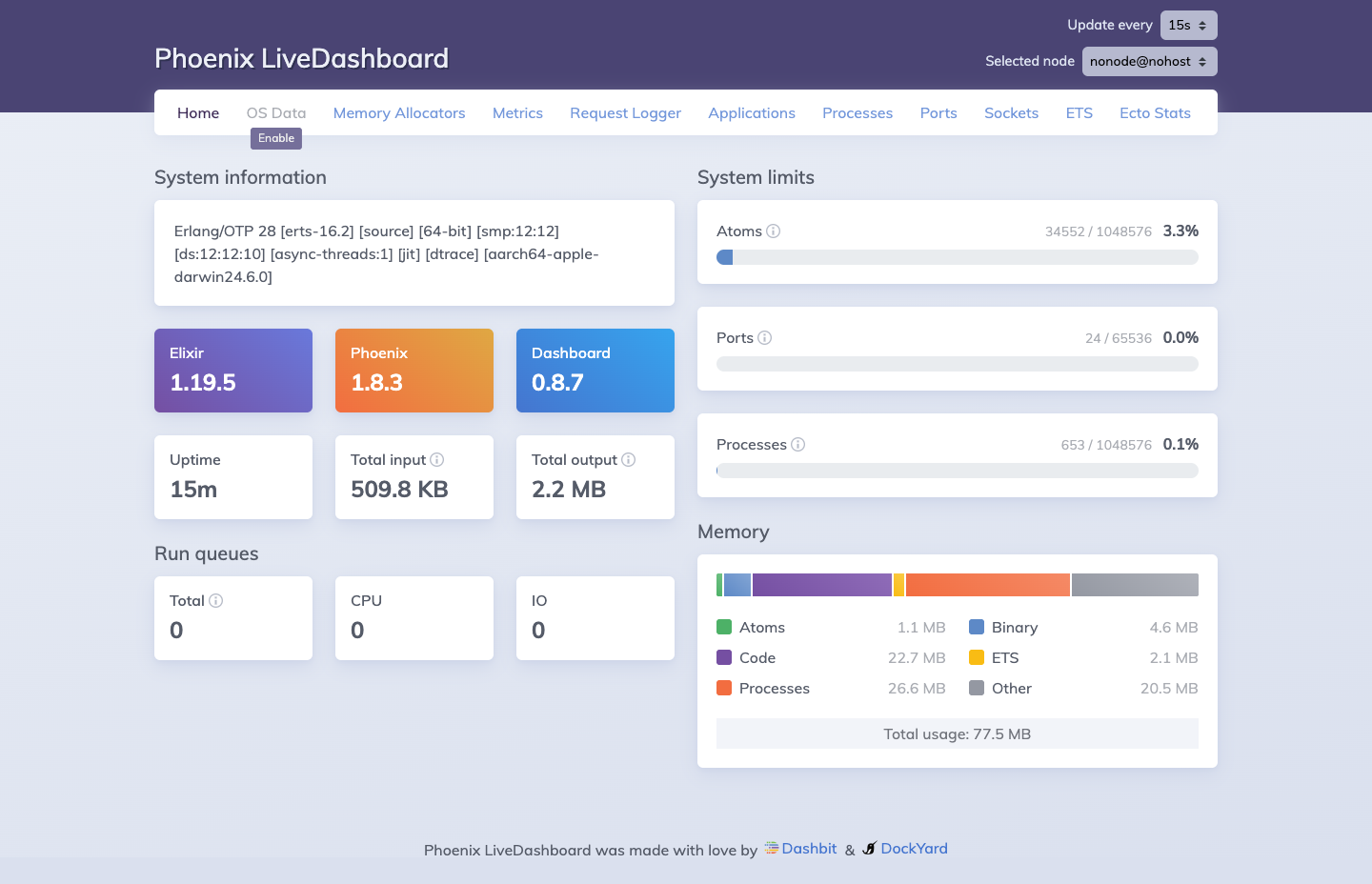 Phoenix LiveDashboard at
 /dev/dashboard. Available in development mode, it provides real-time visibility into Elixir processes, memory allocation, ETS tables, Ecto query stats, and port/socket status.
The Processes tab shows all running Oban queue consumers. The ETS tab exposes the Oban configuration tables. The Ecto Stats tab shows query counts and execution times against the oban_jobs table, which is useful for diagnosing slow job dispatch or large queue backlogs.
Oban Web (Planned)
For production monitoring, Oban Pro includes Oban Web, a LiveView dashboard for inspecting queues, jobs, and workers. The open-source alternative is querying the oban_jobs table directly:
-- Active jobs by queue
SELECT queue, state, count(*)
FROM oban_jobs
GROUP BY queue, state
ORDER BY queue, state;

-- Recent failures
SELECT id, worker, args, errors, attempted_at
FROM oban_jobs
WHERE state = 'discarded'
ORDER BY attempted_at DESC
LIMIT 20;
Telemetry Events
Oban emits telemetry events that can be wired into the existing metrics infrastructure:
# Attach to Oban telemetry in Application.start/2
:telemetry.attach_many(
  "oban-logger",
  [
    [:oban, :job, :start],
    [:oban, :job, :stop],
    [:oban, :job, :exception]
  ],
  &handle_oban_event/4,
  nil
)

defp handle_oban_event([:oban, :job, :stop], measure, meta, _config) do
  Logger.info(
    "Oban job #{meta.worker} completed in #{measure.duration}ns " <>
    "(queue: #{meta.queue}, attempt: #{meta.attempt})"
  )
end

defp handle_oban_event([:oban, :job, :exception], _measure, meta, _config) do
  Logger.error(
    "Oban job #{meta.worker} failed: #{inspect(meta.error)} " <>
    "(queue: #{meta.queue}, attempt: #{meta.attempt}/#{meta.max_attempts})"
  )
end